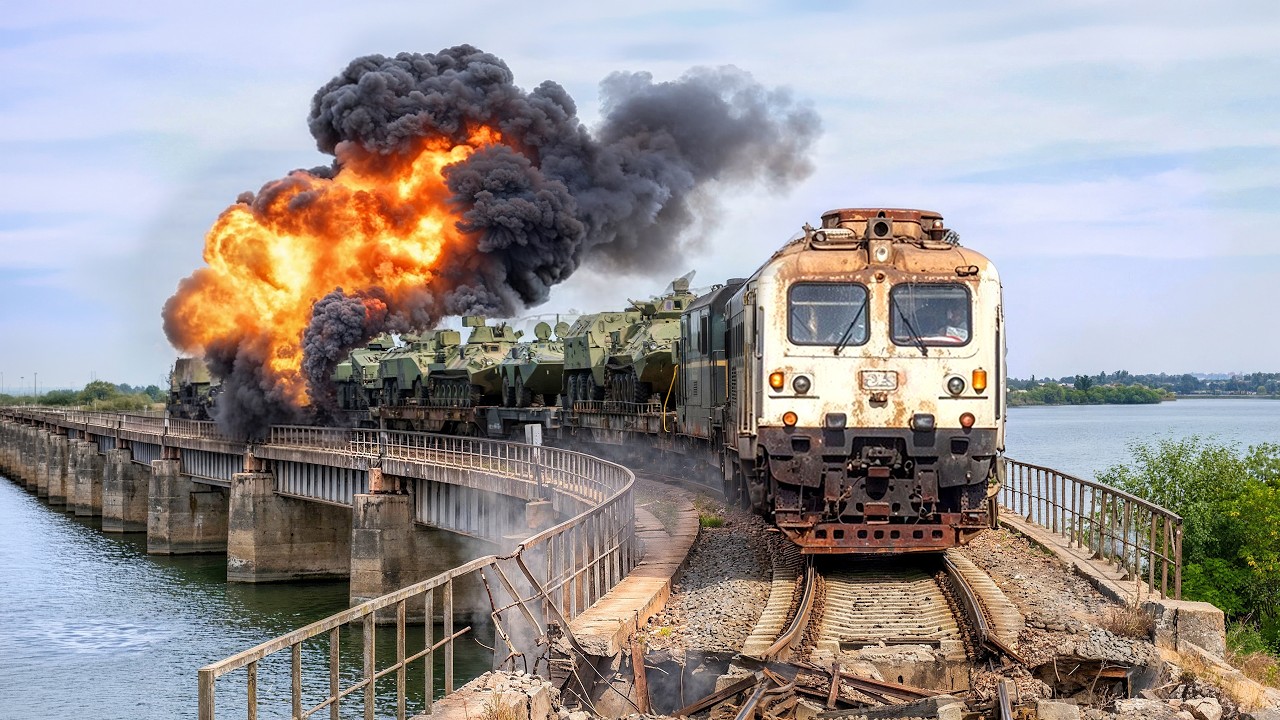
Nine Ukrainian strike drones flew more than two hundred miles into occupied Crimea to hit the last railway bridge still feeding Russia’s southern front. Everything Moscow had between the Syvash salt flats and that bridge was waiting for them. Truck-mounted heavy machine guns sat on the only two dry approaches, and a Tor-M2 launcher was parked where the roads funnel together. Behind them, a Rubikon interceptor team had a rack of Yolka drones ready to go. The wave lost airframes the whole way in. This is how it got there anyway.
We walk through the full run, from the first burst of tracer over the salt flats to the final seconds over the North Crimean Canal. You’ll see why Russia’s drone detectors never heard a Starlink-linked airframe coming, how a Tor’s own radar threw a whole wave out as ground clutter, and what a five-hundred-dollar interceptor did to every gun on the road. Then comes the strike itself, and the reason one drone kept circling in the dark long after the bridge was hit.
On October 10, 2026, Ukrainian drones struck a critical railway drawbridge over the Don River near Rostov-on-Don, jamming its lifting mechanism and completely halting rail traffic in both directions. The attack targeted the Rostov-Bataysk junction, a vital chokepoint that serves as Russia’s primary southern lifeline for transporting armor, fuel, and ammunition directly to the frontlines.
The Fallout: “Then THIS Happened…”
• Massive Rail Gridlock: The strike immediately paralyzed the region’s rail logistics. While Russian officials publicly claimed only 16 trains were delayed, Ukrainian media and intelligence confirmed that more than 25 heavy military and passenger trains were frozen in place, with some delays lasting over four hours. This included key Tavria service lines connecting Moscow and St. Petersburg to occupied Crimea.
• Failure of Russia’s “Frequency Shield”: The most striking revelation came from the partisan group ATESH. Just four days prior to the attack, Russia’s Southern Military District discovered the threat and ordered emergency reinforcements. They deployed Rosgvardia patrols, set up 24-hour watches, and established advanced electronic warfare (EW) units tasked with building an “invisible frequency shield” to jam drone GPS signals. The shield failed completely, exposing significant gaps in Russia’s electronic defenses.
• The “Highway of Death” Bottleneck: With the Kerch Bridge already heavily restricted and local ferry systems vulnerable to ongoing strikes, the disruption forced the Russian military to reroute heavy logistics onto the R280 highway. Because this road runs within striking distance of Ukrainian fire, military analysts and soldiers have dubbed it the “highway of death”.
Though Russian Railways (RZD) scrambled engineers to force the tracks back open within a few hours, the operation successfully proved that Ukraine’s special forces and local partisans can track minor Russian domestic movements in real-time and penetrate heavily defended strategic airspace.