Netanyahu’s Nuclear Warning and Election Controversy
Israeli Prime Minister Benjamin Netanyahu faced intense criticism after sharing a warning that Israel could face another Holocaust if voters failed to re-elect him in the October 27 election.
The controversy erupted on October 25, when Netanyahu shared a social media post featuring an artificial intelligence-generated image depicting a nuclear explosion over Tel Aviv.

The image showed a massive mushroom cloud rising above the city, creating a frightening portrayal of what a potential Iranian nuclear attack could mean for Israel.
The accompanying message warned that Israel faced an existential threat and argued that the country needed strong leadership to confront Iran’s nuclear ambitions.
The post suggested that Israel had a limited opportunity to address the danger while Donald Trump remained president of the United States.
Opposition and Public Backlash
Critics quickly challenged the message, accusing Netanyahu of using public fears about national security to strengthen his position just two days before voters went to the polls.
Among the strongest responses came from opposition leader Gadi Eisenkot, who described Netanyahu’s messaging as hysterical and accused him of relying on fear rather than presenting a convincing political vision.
Other critics argued that the use of an AI-generated nuclear disaster image risked intensifying public anxiety during an already tense election campaign.
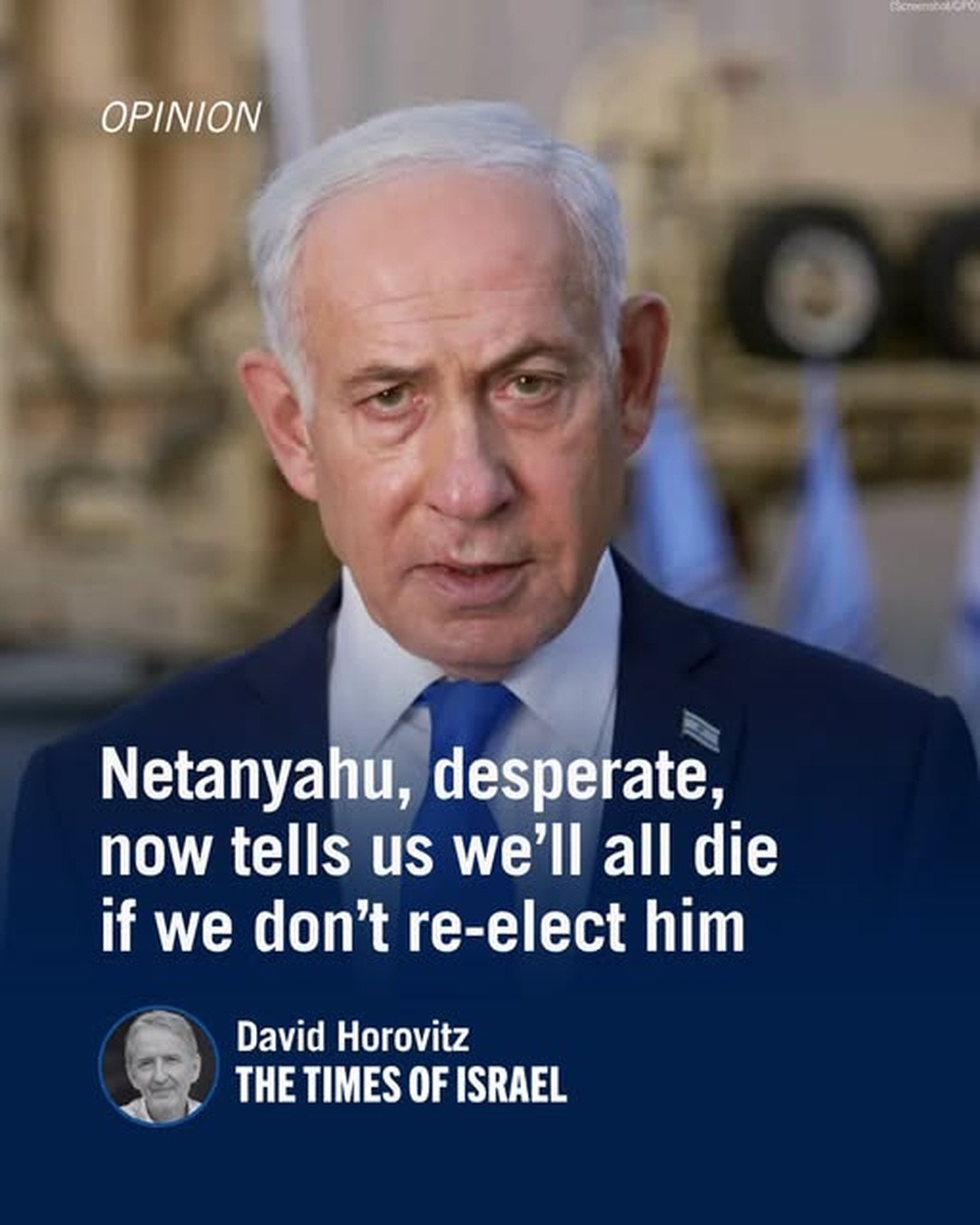
David Horovitz, founding editor of The Times of Israel, published a sharply worded opinion article on October 26, questioning Netanyahu’s motives and political judgment.
Horovitz argued that the prime minister was presenting his continued leadership as essential to Israel’s survival, portraying an electoral defeat as potentially catastrophic for the country.
The columnist also criticised Netanyahu for circulating imagery resembling Iranian propaganda, arguing that the government was using the threat of national destruction as an election message.
Military Concerns and Iranian Operations
A central part of Horovitz’s argument concerned reports that Netanyahu had pressed military leaders to consider an unspecified action relating to Iran shortly before election day.
According to Israeli television reporting cited by Horovitz, IDF Chief of Staff Eyal Zamir was concerned that such an operation could trigger an unintended escalation.
The reports suggested Zamir wanted further consultations and formal legal authorisation before proceeding, reflecting concerns about the possible consequences of military decisions during a sensitive political period.
Netanyahu dismissed the reported confrontation as nonsense, while Defense Minister Israel Katz stated that Israel had no intention of initiating an attack against Iran before the election.
Separately, CNN reported that Netanyahu had sought American support for renewed military action against Iran, but the Trump administration had not approved an immediate operation.
The Israeli Prime Minister’s Office rejected CNN’s account as fake news, leaving important questions about the alleged discussions unresolved.
Election Results and Broader Questions
The controversy unfolded against the background of a prolonged confrontation with Iran, whose nuclear programme has remained one of Israel’s central national security concerns.
Israel’s October 27 election produced no clear parliamentary majority. Final results placed Netanyahu’s bloc at 53 seats and the opposition bloc led by Eisenkot at 48, leaving coalition negotiations ahead.
The result demonstrated that Netanyahu retained significant political support, but his opponents continued challenging his leadership, security decisions and use of national threats during the campaign.
Ultimately, Horovitz’s article raises a broader question about the relationship between national security and electoral politics: whether warnings about genuine dangers can become political tools when public fear influences the choices voters make.