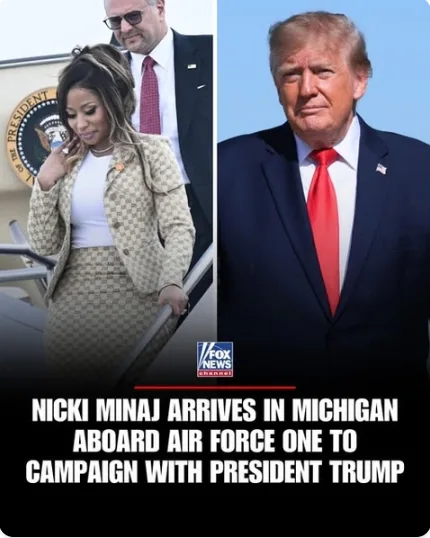
NICKI MINAJ BOARDS AIR FORCE ONE WITH TRUMP — THEN MAKES A DECLARATION THAT ROCKS THE POLITICAL WORLD: “I WILL SUPPORT YOU FOREVER”
The rap superstar’s surprise appearance at a Michigan campaign rally has ignited a national debate over celebrity influence, political loyalty, and the changing face of America’s midterm elections.
PORT HURON, MICHIGAN — October 26, 2026 — The aircraft was Air Force One. The destination was Michigan. And the passenger who ultimately commanded a remarkable share of the political spotlight was not a senator, a governor, or a veteran Republican strategist.
It was Nicki Minaj.
The internationally recognized rap superstar traveled aboard President Donald Trump’s aircraft before appearing alongside him at a Republican campaign rally in Port Huron on Sunday, October 25. There, in front of a crowd gathered for the final stretch of the 2026 midterm campaign, Minaj made a public declaration of support that immediately attracted national attention.
“President Trump, it is an honor to stand with you every single time,” she told the audience. “And I will continue to support you forever and ever. If you run again, I will support you again.” Fox News reported the remarks, which were also covered by Euronews.
The declaration was striking not simply because of its language, but because of the setting.
Minaj was no longer commenting from a distance on a political controversy or expressing an opinion through a social media post. She had boarded the presidential aircraft, appeared at a campaign event with the president, and used a major public platform to encourage support for Republican candidates.
For a performer whose career has been defined by chart-topping records, provocative performances, and a fiercely independent public persona, the appearance represented another unmistakable step into America’s political spotlight.
And it raised a question that neither party can easily ignore: When one of the world’s most recognizable entertainers publicly aligns herself with a president, how much can that moment change the political conversation?
THE AIR FORCE ONE ARRIVAL THAT PUT NICKI MINAJ AT THE CENTER OF THE STORY
Air Force One is more than a mode of transportation. It is one of the most recognizable symbols of the American presidency, associated with executive power, international diplomacy, and the president’s movements across the country.
For Minaj, the journey offered a highly visible introduction to the political event that awaited her.
According to Fox News and other reports published on October 26, the rapper traveled with Trump to Michigan before joining him onstage at the Port Huron rally. Footage from the trip was circulated online, including a video shared by White House Communications Director Steven Cheung. Fox News video
The footage drew attention because it showed an entertainer who had increasingly voiced support for Trump moving into a setting normally associated with senior government officials, political advisers, and campaign figures.
The symbolism was difficult to miss.
A celebrity appearance at a rally is one thing. Traveling with the president aboard his aircraft before joining him before a cheering crowd creates a different kind of spectacle.
It places the celebrity inside the machinery of a presidential campaign, even if the celebrity holds no government position and has no formal role in shaping policy.
For Trump’s campaign, Minaj’s presence brought additional entertainment-industry recognition to an event intended to mobilize Republican voters.
For Minaj, it provided a platform from which she could make her political position unmistakably public.
And for the media, it created a story that extended well beyond the boundaries of a conventional campaign speech.
The resulting attention was not limited to the flight itself. The most consequential moment came when Minaj stepped onto the stage and addressed the crowd directly.
“WE LOVE TRUMP!” — THE MOMENT THE CROWD JOINED IN
When Trump introduced Minaj to the audience, he called her the “queen of rap,” according to Fox News’ account of the event.
The rapper responded by engaging the crowd in chants of support.
“We love Trump! We love Trump,” she told the audience, according to local reporting by MLive.
The moment brought two different forms of public recognition together: the familiarity of a global music star and the political energy of a presidential campaign rally.
Then Minaj turned directly to the president.
She praised his resilience, described his return to the White House as having changed the country’s political atmosphere, and spoke positively about the future she believed his leadership offered Americans and their children.
“I am so honored to be working with this president. He represents resilience,” she said, according to Fox News.
She continued: “Since he’s come back, he’s changed the energy of our country. And he’s given us a future to look forward to, a brighter future for us and our children.”
Her remarks were not a vague expression of admiration. They were an explicit public endorsement, accompanied by a call for voters to support Republican candidates in the upcoming elections.
“We really need all of these great people to be elected,” Minaj said, according to the published reports.
She also described the election as a major turning point for the country.
That message connected her appearance to the immediate purpose of the event: helping Republican candidates reach voters before Election Day.
The rally was not simply a meeting between a president and a celebrity. It was a campaign event, and Minaj used her time onstage to encourage political participation in support of the candidates sharing the platform.
Her words therefore carried significance beyond the headline-grabbing image of a rap superstar standing beside the president.
They placed her directly within a campaign effort aimed at influencing the outcome of competitive races.
TRUMP’S CAMPAIGN HAD TWO MAJOR MICHIGAN RACES IN ITS SIGHTS
The Port Huron rally took place as Republicans sought to strengthen their position in Michigan ahead of the November 3 midterm elections.
Trump was campaigning for Mike Rogers, the Republican Senate candidate, and John James, the Republican candidate for governor.
Both contests were part of the broader struggle for political power that was unfolding across the country.
Michigan is an important battleground because its statewide elections can have consequences extending beyond the state’s borders. The Senate contest, in particular, forms part of the national effort to determine the balance of power in Congress.
Rogers was running against Democrat Abdul El-Sayed, while James was seeking the governorship against Democrat Jocelyn Benson.
The candidates were advancing their own policy arguments and campaign messages, but Trump’s presence added the national spotlight to their races.
Minaj’s appearance added another layer.
A conventional campaign speech might attract local news coverage and the attention of voters already following the election. The appearance of a globally recognized musician can reach entertainment audiences, music fans, and social media users who might not otherwise watch a full political rally.
That does not automatically translate into additional votes.
A celebrity endorsement cannot, by itself, establish that a candidate will gain support or that undecided voters will change their minds. The impact depends on numerous factors, including the candidate’s record, the issues that matter to voters, campaign organization, and turnout.
Nevertheless, the communication value is clear: a recognizable celebrity can introduce a campaign message to audiences well beyond the event venue.
For Trump, Minaj’s participation gave the rally another prominent talking point.
For Rogers and James, it put their campaigns before viewers who might first encounter the event through a headline about the rapper rather than through a story about Michigan’s Senate or gubernatorial races.
That distinction matters in an election season when political campaigns compete not only for votes, but also for attention.
THE SURPRISE WHITE HOUSE JOB JOKE THAT FUELED THE SPECULATION
The rally was not the only reason Minaj’s visit became a talking point.
Before the event, footage from aboard Air Force One circulated online showing Minaj interacting with a member of the president’s communications team.
Cheung, the White House communications director, subsequently joked on social media that the rapper might be the next White House press secretary.
“Ladies and gentlemen, I think we may have found the new White House press secretary!” he wrote in a post tagging Minaj, as reported by Fox News.
The comment was presented as a joke, not an official appointment announcement.
Even so, it provided another memorable element for coverage of the trip.
The idea of a globally famous rapper stepping into the White House briefing room was an obvious source of speculation and humor. It also highlighted how modern political communication increasingly blends official messaging, celebrity culture, internet humor, and carefully circulated video clips.
The distinction between a joke and an actual personnel decision remains important.
There was no basis in the cited reporting to treat Cheung’s comment as confirmation that Minaj had been offered or appointed to a government position.
Nor does appearing aboard Air Force One establish that a passenger has been given policymaking authority.
What the footage did demonstrate was that Minaj’s presence had become part of the administration’s public-facing political narrative.
The joke generated another wave of attention around her visit, helping transform a campaign appearance into a wider conversation about celebrity access, public relations, and the changing presentation of political power.
And it invited a larger question: In an era when a short video can reach millions of people, can the attention generated by a celebrity sometimes become as important to a campaign’s public image as the formal speeches delivered onstage?
FROM CRITICISM OF TRUMP’S IMMIGRATION POLICIES TO PUBLIC SUPPORT
Perhaps the most intriguing part of Minaj’s political evolution is that her relationship with Trump has not always been characterized by the public support seen in Michigan.
During Trump’s first presidency, Minaj criticized aspects of his administration’s immigration policies, particularly the separation of migrant children from their parents at the U.S. border.
Her more recent appearances and public statements have reflected a stronger alignment with Trump and Republican political messaging.
That shift has drawn attention because Minaj is not a conventional political figure.
She built her public identity through music, performance, and an outspoken persona that has often resisted easy categorization. Her enormous profile means that statements about politics can become news far beyond the usual audience for campaign coverage.
Her support for Trump has become increasingly visible through public appearances and comments, including her participation in administration-associated events and her involvement in a Small Business Administration initiative.
The Michigan rally added a particularly direct expression of that support.
Yet a change in political alignment should not automatically be reduced to a single motive. Public figures may change their views, emphasize different issues, respond to new experiences, or decide that a particular administration’s policies align more closely with their current priorities.
Without a detailed explanation from Minaj herself, it would be speculative to claim that one specific factor accounts for her evolving political position.
What can be established from her public remarks is that she expressed strong support for Trump at the Michigan event and urged voters to support Republican candidates.
The broader story is one of a celebrity increasingly willing to make her political views part of her public identity.
For fans, that can be welcome, disappointing, or controversial, depending on their own beliefs.
For political observers, it offers a case study in how entertainment figures can become visible participants in national political debates.
THE COMMENTS ON TRANSGENDER ISSUES ADDED ANOTHER POLITICAL DIMENSION
Minaj’s appearance was not limited to praise for Trump.
She also addressed transgender-related issues involving children, using language that aligned with the Republican position opposing gender-affirming medical interventions for minors.
“We don’t want our children to be bombarded with sex changes, right?” she said, according to Fox News’ reporting.
She continued by urging people to leave children out of the dispute.
The comments introduced a substantive policy issue into what might otherwise have been covered primarily as a celebrity endorsement.
Gender-affirming care for minors is a subject of intense political, medical, and legal debate in the United States. Different states have adopted different laws and policies, while medical organizations, families, lawmakers, and advocacy groups disagree over questions of appropriate treatment, parental authority, and the rights of young people.
Minaj’s remarks reflected her stated position at the rally. They should not be mistaken for a comprehensive explanation of the medical evidence or the legal landscape.
Her appearance nonetheless illustrated how celebrity participation can bring contentious policy questions into entertainment coverage.
A reader who initially encounters a story because of Minaj’s presence on Air Force One may subsequently encounter debates about healthcare, parental rights, and the responsibilities of government.
That is one reason celebrity endorsements can have consequences beyond the campaign event itself.
They can introduce political subjects to new audiences, even when the celebrity’s remarks do not settle the underlying questions.
The same dynamic applies across the political spectrum. When entertainers speak publicly about immigration, healthcare, economic policy, or civil rights, they can influence which issues receive attention without necessarily changing how every listener understands those issues.
In Minaj’s case, the rally gave her a platform to express both personal support for Trump and views on a divisive policy debate.
The reaction to those statements is likely to vary widely, reflecting the divisions already present in American public life.
WHY A CELEBRITY ENDORSEMENT CAN MATTER — AND WHY ITS IMPACT IS HARD TO MEASURE
The political value of celebrity endorsements has long been debated.
Famous entertainers bring name recognition, established audiences, and the ability to attract media coverage. Their public appearances can generate photographs, video clips, interviews, and online discussion that extend the reach of a campaign event.
But visibility and persuasion are not the same thing.
A supporter who already intends to vote Republican may welcome Minaj’s endorsement as confirmation of an existing political preference. Another viewer may enjoy her music but disagree with her political views. Someone else may pay attention to the story without changing their voting intentions at all.
Campaigns therefore face a difficult question: Does a celebrity appearance persuade new voters, strengthen existing supporters, or primarily generate attention?
The answer depends on the circumstances, and the effects can be difficult to isolate.
A campaign event may attract substantial coverage because of a famous guest, but that does not prove the guest changed anyone’s vote. Measuring such an effect would require evidence beyond photographs, online engagement, or the size of the crowd.
The Port Huron rally illustrates the distinction.
Minaj’s appearance generated national coverage, and her statements provided the media with clear quotations about her support for Trump. Those are observable outcomes.
Whether her endorsement changes the behavior of Michigan voters is a separate question.
It would be premature to infer an electoral effect without reliable evidence.
Still, campaigns have a practical reason to seek celebrity participation: political communication does not happen only through policy papers, television interviews, or traditional campaign advertisements. It also happens through cultural figures whose audiences extend into different communities and age groups.
For some voters, a celebrity’s political engagement may encourage greater interest in an election. For others, it may reinforce existing views or produce no meaningful change.
The endorsement itself does not determine which outcome occurs.
THE BIGGER PICTURE: WHEN ENTERTAINMENT AND POLITICS COLLIDE
Minaj’s journey aboard Air Force One and her appearance beside Trump offer a snapshot of a broader transformation in American political communication.
Campaigns increasingly operate in an environment where the boundaries between news, entertainment, social media, and official messaging are porous.
A presidential rally can become a major entertainment story. A brief joke by a communications official can trigger speculation about a government appointment. A celebrity’s statement can circulate independently of the speech in which it was delivered.
That environment creates opportunities for political figures to reach audiences who might otherwise ignore conventional campaign coverage.
It also creates risks.
When attention centers on personalities, the policy positions of candidates may receive less scrutiny than their most recognizable supporters. A dramatic photograph can dominate a news cycle even when the decisions being contested have far more direct consequences for voters.
The challenge for journalists and audiences is to distinguish the spectacle surrounding an event from the substance of what happened.
Minaj’s endorsement is a documented public statement. Her presence on Air Force One and at the rally is a reported event. Cheung’s suggestion about the press secretary role was a joke, not an appointment.
The potential impact of the endorsement, by contrast, remains uncertain.
Keeping those distinctions clear makes it possible to understand the political significance of the appearance without exaggerating what it proves.
The episode also demonstrates that celebrities do not simply carry the same political meaning for every audience. Supporters may view Minaj’s appearance as a sign that Trump’s coalition reaches beyond conventional political circles. Critics may question the value of celebrity involvement or challenge the positions she expressed.
Others may be more interested in the candidates themselves and the issues facing Michigan.
All three reactions can coexist.
The central question is not whether a celebrity endorsement automatically changes an election. It is how political campaigns use cultural influence, and how voters decide what weight to give it.
NOVEMBER 3 IS APPROACHING — BUT THE BIGGEST QUESTION REMAINS UNANSWERED
As the midterm campaign approaches Election Day on November 3, the Port Huron rally provides a vivid example of how American political campaigns compete for public attention.
Trump used the event to campaign for Republican candidates Mike Rogers and John James. Minaj appeared beside him, expressed continued support, and encouraged the audience to back the candidates.
Her remarks were direct. Her presence was highly visible. The resulting coverage extended well beyond Michigan.
But the political consequences cannot be determined from the appearance alone.
Voters will make decisions based on their own priorities, including the economy, healthcare, immigration, education, public safety, and the candidates’ records. Campaign organization, local concerns, turnout, and the wider national political climate will also matter.
A celebrity endorsement can become a defining media moment without becoming a defining electoral moment.
That is the distinction separating a viral headline from a measurable political outcome.
For Minaj, the rally marked another public step into a political arena she once approached more critically. For Trump, her presence added a prominent entertainment figure to a campaign effort intended to mobilize Republican voters. For Michigan’s candidates, the appearance offered another opportunity to reach an audience during the final days of the campaign.
And for the public, it raised a question that will outlast the news cycle:
When a beloved entertainer takes a stand in politics, do audiences follow the celebrity, reconsider their own views, or simply watch the spectacle unfold?
There is no universal answer.
What is clear is that Minaj’s appearance aboard Air Force One and her declaration of continued support for Trump have become part of the public conversation surrounding the 2026 midterms