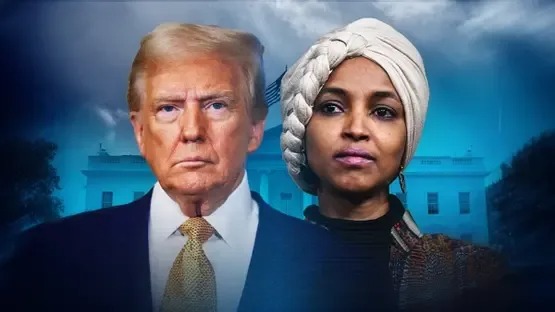
Trump’s “Get Out” Demand and the Political Showdown
The words were blunt, the setting was explosive, and the timing raised a question Washington could not easily ignore: Was Donald Trump simply attacking one of his fiercest political critics—or was his latest demand aimed at sending a much broader message about who belongs in America?
President Donald Trump reignited his long-running confrontation with Democratic Rep. Ilhan Omar after federal agents searched her Washington-area home as part of an investigation into decades-old immigration paperwork. At a rally in Youngstown, Ohio, on October 12, Trump attacked Omar over her Somali origins and her defense of her constitutional rights, declaring that she should “get the hell out” of the country.

The remarks came just hours after the search, turning an already sensitive federal investigation into a national political flashpoint. As some rallygoers chanted “Deport,” Democrats and Omar’s supporters questioned whether the president’s rhetoric was encouraging hostility toward a sitting member of Congress—and whether the timing of the investigation could be justified so close to the November midterm elections.
Trump’s Words Turned a Federal Investigation Into a Political Showdown
Trump has criticized Omar for years, making her a recurring target in his broader attacks on progressive Democrats and immigration policies. But the latest remarks carried added weight because they followed a federal search of the congresswoman’s residence.
According to reporting by The Associated Press, federal agents searched Omar’s home under a judicially authorized warrant. The investigation concerns whether Omar or members of her family provided false information in immigration or naturalization paperwork dating back decades.
At the Ohio rally, Trump moved beyond criticism of Omar’s political positions. He disparaged Somalia and questioned why Omar invoked constitutional protections in the United States. The crowd’s chants of “Deport” amplified the confrontation, creating a scene that quickly drew national attention.
For Omar’s critics, the episode reinforced their longstanding objections to her politics and immigration views. For her supporters, the president’s language raised a different concern: whether a naturalized American citizen and elected representative was being publicly portrayed as someone who did not belong in the country.
Those competing interpretations now sit at the center of a widening political dispute.
The Search That Intensified the Controversy
The investigation itself is serious, but its legal status matters.
Reuters reported on October 16 that the search was connected to an inquiry into Omar’s decades-old immigration and naturalization records. People familiar with the investigation said the warrant identified potential offenses under investigation, including conspiracy, false statements on immigration paperwork and immigration fraud.
Those are investigative allegations—not findings of guilt. As of October 18, public reporting had not established that Omar had been indicted on those allegations, and she has denied wrongdoing.
Omar arrived in the United States as a Somali refugee in 1995 and became a naturalized citizen in 2000. She has described the search as political intimidation and rejected the suggestion that she committed immigration fraud.

The distinction is crucial. A search warrant authorizes investigators to look for specified evidence; it does not establish that a crime occurred. Any criminal case would have to be supported by evidence and proceed through the legal system.
The possibility of consequences involving citizenship has also entered the public debate. Reuters reported that one potential aim being considered by investigators could be denaturalization and deportation. But that possibility is not the same as a formal decision to revoke citizenship, and neither outcome is automatic.
Why Democrats Are Questioning the Timing
The timing has become one of the most contentious aspects of the case.
The search occurred only weeks before the November midterm elections, when control of Congress is at stake. Omar is a prominent Democratic lawmaker and a frequent Trump critic, making the public fallout especially politically charged.
The Justice Department has traditionally exercised caution around investigative steps involving political candidates shortly before an election, particularly when those steps could become public. That principle is intended to reduce the risk that law enforcement activity will be perceived as influencing voters.
Critics argue that the age of the records under scrutiny raises questions about why the search happened now. The Washington Post also reported that a review of Omar’s immigration history during Trump’s first administration in 2019 did not uncover sufficient evidence of wrongdoing to warrant a full investigation, according to former immigration officials.
That earlier review does not settle the merits of the current inquiry. Investigators can revisit matters if new evidence emerges, and the public record does not establish that the present investigation has no legitimate basis.
Still, the sequence of events has intensified concerns about political impartiality. Omar’s attorneys have separately accused federal authorities of failing to follow restrictions imposed by the judge who approved the search. Those claims are disputed allegations from her legal team, not a final judicial finding.
The central question is whether investigators can demonstrate a sound legal basis for their actions—and whether the process has respected the protections afforded to a sitting member of Congress.
A Citizenship Debate With Consequences Beyond Omar
Trump’s demand has also reignited a broader debate over immigration, citizenship and national identity.
Omar is a naturalized citizen who represents a Minnesota district in the House of Representatives. Her political career has made her a prominent figure in debates over immigration and the rights of newcomers, while her background has repeatedly featured in attacks from Trump and some of his allies.
The legal question of citizenship, however, cannot be resolved by a rally speech or a political accusation.
Under U.S. law, naturalized citizenship can be revoked only through a legally established process and on qualifying grounds. The government would need to meet the applicable legal standards; public criticism alone cannot strip someone of citizenship.
The controversy also extends beyond Omar personally. Community advocates have expressed concern that attacks on one Somali American politician could contribute to suspicion toward Somali immigrants and Somali Americans more broadly. Omar’s supporters argue that criticism of an elected official should not become a blanket judgment about people who share her heritage.
Trump and his supporters, meanwhile, have framed their concerns around immigration enforcement, alleged fraud and what they see as failures in Democratic leadership. Those political arguments remain distinct from the question of whether investigators can prove a specific legal violation.
What Happens Next Could Matter More Than the Rally
For now, the dispute has two parallel tracks: the legal investigation and the political battle over what it represents.
Investigators must establish whether the evidence supports any charges. Omar and her attorneys are challenging the search and questioning the government’s handling of the matter. Meanwhile, Trump’s public demand has intensified scrutiny of his rhetoric and the administration’s use of federal law enforcement in a politically sensitive period.
The investigation may ultimately produce evidence supporting charges, or it may fail to establish wrongdoing. The public record has not yet settled that question. Nor does the search itself prove that Trump personally directed the operation; he has said he had nothing to do with it.
What is already clear is that the episode has become more than a dispute between a president and a congresswoman. It has raised questions about the boundary between political speech and government power, the treatment of naturalized citizens, and the safeguards meant to keep criminal investigations separate from electoral combat.
Trump’s “get out” demand delivered a dramatic rally moment. But the lasting consequences will depend on what investigators can establish, what the courts determine and whether the government can demonstrate that the law—not political hostility—guided its actions.