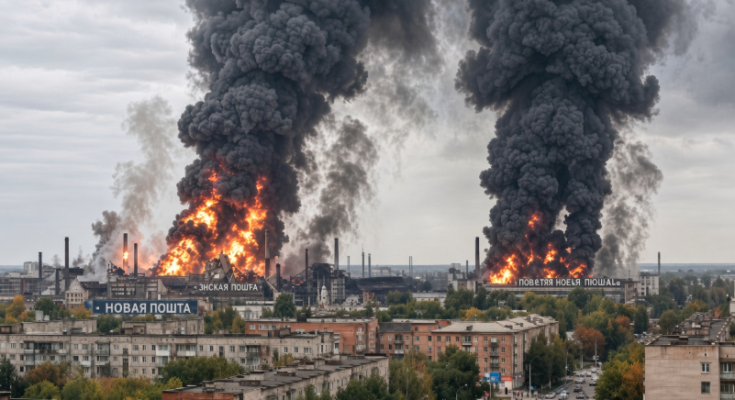
Ukraine is reportedly expanding drone attacks against Russian industrial facilities that supply materials for both civilian manufacturing and military production. According to statements from Ukrainian defense company Fire Point, FP-1 drones have struck three rubber-industry plants: Voronezhsintezkauchuk, Omsk Kauchuk, and Togliattikauchuk. The company says some polymers produced by these facilities can be used in solid rocket propellants, potentially linking the chemical sector to Russia’s missile supply chain.
Documented Attacks and Damage Claims
Fire Point claims that Togliattikauchuk has been attacked at least four times and that six of Russia’s approximately ten major rubber-industry enterprises had experienced a combined 11 successful attacks by October 25. These figures and the extent of damage require independent verification. The plant produces synthetic rubber, monomers, chemical fractions, and gasoline additives for several industrial sectors.
Strategic Military Implications
The strategic rationale is to disrupt materials that may support solid-propellant production for systems such as Russia’s Iskander-M missiles. However, the effect of attacks on individual chemical plants depends on production losses, existing inventories, alternative suppliers, and the availability of substitute materials. A strike does not automatically mean that missile production has stopped.
Additional Targeted Facilities
Ukraine has also reported attacks on other defense-related facilities, including the Yefremov Synthetic Rubber Plant in Tula Oblast and the Zavod Iskra plant in Ulyanovsk. Ukrainian officials describe these sites as contributing to rocket-fuel production or military electronics and missile systems. Those roles and the extent of damage should be assessed through independent evidence.
If corroborated, the attacks would illustrate Ukraine’s effort to pressure Russia’s military-industrial network by targeting upstream suppliers as well as finished weapons and frontline assets.